Inside the Cockpit of Your Mind: How Elite FPV Racers Are Training Their Brains
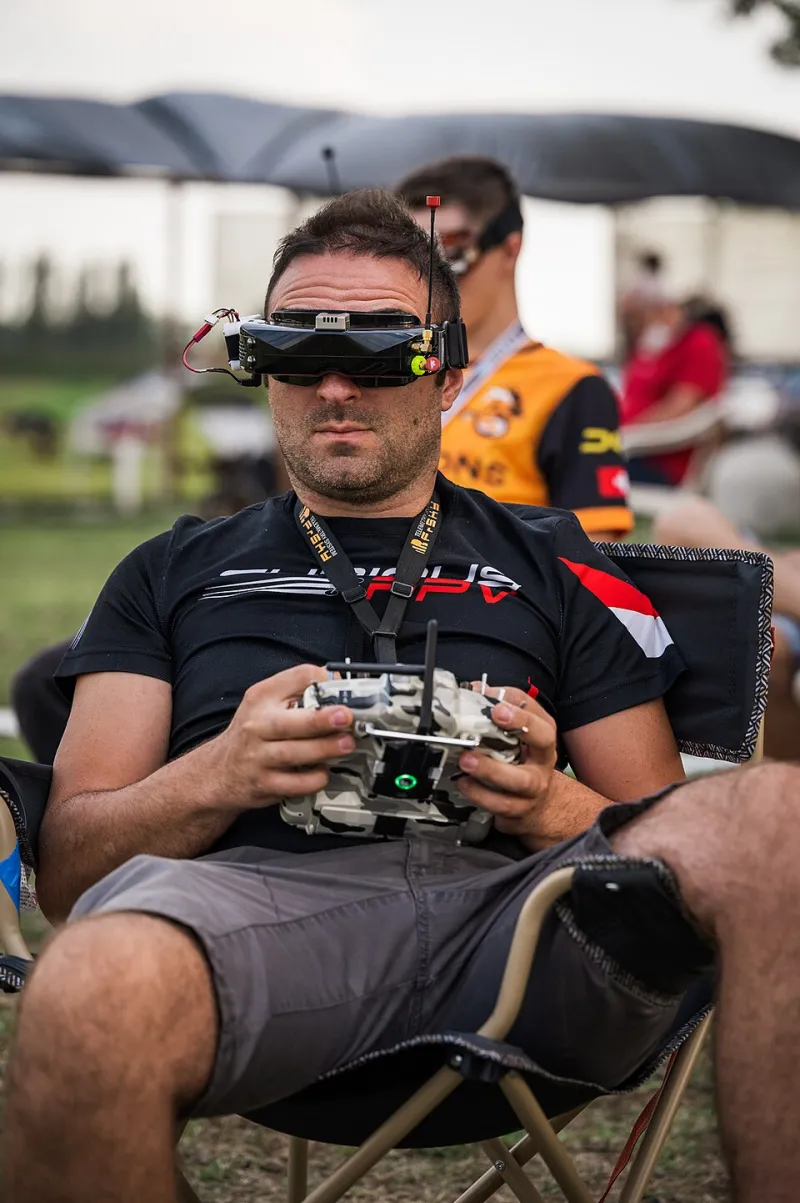
Photo: Commanderbryce, CC BY-SA 4.0, via Wikimedia Commons
Everybody obsesses over the hardware. Motor KV ratings, prop pitch, ESC firmware — the forums are packed with it. But ask any pilot who's stood on the podium at a MultiGP Regional or watched someone else take first by two-tenths of a second, and they'll tell you the same thing: the biggest performance variable isn't on your quad. It's you.
The mental side of competitive FPV racing doesn't get nearly the attention it deserves. That's starting to change.
The Reaction Time Reality Check
Here's a number worth sitting with: the average human reaction time hovers around 250 milliseconds. In a gate-to-gate sprint at 80-plus miles per hour, that's the difference between a clean pass and a shower of carbon fiber. FPV racing demands split-second corrections that happen almost below the level of conscious thought — which means the pilots winning consistently aren't just reacting faster, they're building mental models of the course so deeply ingrained that their thumbs move before their brain fully processes the input.
That's not a metaphor. That's neuroscience.
Researchers studying esports athletes — the comparison is more apt than it sounds — have documented how elite players develop something called "perceptual-cognitive expertise." Basically, their brains pattern-match faster than novices because they've logged enough repetitions to build stronger neural pathways. Top FPV racers are doing the same thing, whether they call it that or not.
Visualization: It's Not Just Woo-Woo Stuff
Talk to any pilot who's been competing seriously for a few years and visualization comes up almost immediately. The practice is deceptively simple: before a race run, you close your eyes and fly the course mentally — gate by gate, corner by corner — at full speed. You feel the throttle inputs, you anticipate the breakover on that tricky gap gate, you see the finish line.
This isn't just a confidence trick. Mental rehearsal activates many of the same neural circuits as physical practice. Studies in traditional sports psychology have shown that athletes who combine physical training with structured visualization outperform those who only train physically. The FPV community has arrived at this conclusion independently, through trial and error on the flight line.
The key distinction pilots make is specificity. Vague "I'm going to fly great" visualization does almost nothing. Detailed, course-specific mental walkthroughs — ideally done after watching DVR footage of the track from a pilot's perspective — actually move the needle. Some pilots walk the course on foot first, mapping the geometry into their heads before ever putting on goggles.
Heart Rate, Stress, and the Throttle-Shake Problem
Anyone who's flown in a high-stakes heat knows the feeling: palms get clammy, the controller suddenly feels unfamiliar, and inputs that were butter-smooth in practice start getting choppy. Your heart rate has spiked, cortisol is flooding your system, and your fine motor control is taking a hit.
This is where some of the more forward-thinking pilots in the US scene are borrowing directly from esports performance coaching. Wearables like the Whoop band or Garmin's stress tracking tools are showing up in pilot bags alongside spare props and LiPo chargers. The goal isn't just to see what your heart rate is doing — it's to understand your personal arousal curve and learn where your performance peaks.
Too calm and you're not sharp. Too amped and your hands betray you. Finding that window — and being able to dial into it on demand — is a trainable skill. Breathing protocols borrowed from military and athletic performance training (box breathing, in particular, has a devoted following in the community) help pilots hit that zone before they drop into the start gate.
The Meditation Pipeline Nobody Talks About
It sounds counterintuitive for a motorsport built on adrenaline, but meditation — specifically mindfulness-based attention training — has a growing quiet fanbase among serious FPV competitors. The pitch isn't about relaxation. It's about attention control.
Racing at speed through a complex course means your attention is constantly being pulled in multiple directions simultaneously. A burst of static in your goggles, a competitor in your peripheral view, the sound of a crash somewhere on course — any of it can steal your focus at exactly the wrong moment. Meditation practice, particularly the kind that trains you to notice distractions without following them, builds the mental filtering that keeps pilots locked in during chaos.
Apps like Headspace and Waking Up get name-dropped in Discord servers more than you'd expect. Some pilots do as little as ten minutes a day. The consistent report is that it takes several weeks to feel anything, and then it quietly becomes non-negotiable.
Building Your Own Off-Throttle Training Stack
You don't need a sports psychologist on retainer to start taking this seriously. Here's what the community consensus looks like for pilots trying to level up the mental game:
Sim hours with intention. Velocity Drone or Liftoff time only counts if you're actually practicing under simulated pressure — timed laps, not casual flying. Treat simulator sessions like race runs.
Course visualization before every practice session. Even if it's just two minutes. Specificity over duration.
Track your stress, not just your laptimes. If you're wearing a fitness tracker anyway, start correlating your heart rate data with how your flying felt. Patterns emerge fast.
Debrief your mental state, not just your crashes. After a bad race run, ask whether the issue was technical or cognitive. Were you tight? Distracted? Rushing? The fix is different for each.
Rest like it matters. Sleep deprivation tanks reaction time faster than almost any other variable. Showing up to an event on five hours of sleep is leaving lap time on the table.
The Competitive Edge Nobody's Selling
The FPV industry is excellent at selling you hardware upgrades. Stack swaps, new frames, lighter props — there's always something to buy. But the mental training stack costs almost nothing and is almost entirely overlooked by your competition.
The pilots who are already working this angle quietly aren't broadcasting it. They're just showing up, staying smooth when it matters, and cashing the checks. The cockpit of your mind is the one piece of gear nobody can spec-match or outspend. Might be worth putting some time on it.