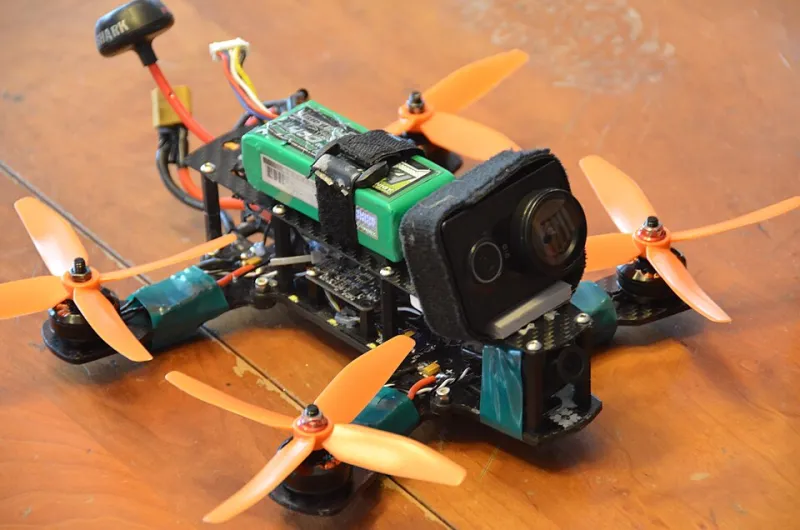
Garage to Grid: The American Tinkerers Reinventing FPV Quad Design from Scratch
Photo: DIY drone builder workshop 3D printing FPV quad design basement, via www.the36thavenue.com
There's a particular kind of energy in a garage workshop at 11pm on a Tuesday. The kind where someone has three browser tabs open, a half-assembled quad on the bench, and a notepad covered in geometry sketches that may or may not lead somewhere useful. It's not glamorous. It's also, increasingly, where some of the most interesting ideas in FPV racing are coming from.
The established brands — your Iflight, your Armattan, your TBS — still dominate the market. But underneath that mainstream layer, something genuinely interesting is happening in the American FPV community. A growing number of pilots are stepping off the consumer conveyor belt and building their own frames from the ground up, sometimes with access to nothing more than a 3D printer, a sheet of carbon fiber, and a friend who runs a small CNC operation out of a machine shop in Ohio.
The Itch That Off-the-Shelf Can't Scratch
Ask any pilot who's gone down the custom design rabbit hole, and you'll hear a version of the same story. They were flying a production frame, they had an idea — maybe a different arm angle, a lower stack position, a wider stance for a specific track type — and they realized there was no product on the market that matched what they were imagining. So they started drawing.
For a lot of these builders, CAD software was the first real barrier. Programs like Fusion 360 have democratized mechanical design in a meaningful way, and the FPV community has been an enthusiastic adopter. There are entire Discord servers and subreddit threads dedicated to first-time frame designers sharing files, getting feedback, and iterating on designs in a way that would have been unimaginable ten years ago.
What's changed more recently is access to fabrication. Carbon fiber cutting used to require either an expensive local shop or shipping files overseas with a two-week turnaround. Now there are US-based services — some of them run by FPV pilots themselves — that will cut a small batch of custom frames for a reasonable price. Minimum order quantities have dropped dramatically, which means a pilot can prototype a new design, fly it for a few weeks, make changes, and run another batch without spending thousands of dollars.
Geometry Gets Weird (In a Good Way)
One of the most interesting trends coming out of the DIY scene is a willingness to experiment with frame geometries that the major manufacturers have largely avoided. The commercial market gravitates toward proven configurations because they're easier to sell — a stretched-X with 5-inch props is a known quantity, and most pilots know what to expect from it.
Independent designers aren't carrying that same commercial risk, which means they're free to get strange. Some builders are revisiting deadcat configurations — where the front arms are angled forward to keep props out of the camera view — and finding that modern flight controller software handles the asymmetric motor layout far better than it did five years ago. Others are experimenting with true asymmetric designs, where front and rear arm lengths are deliberately different to shift the center of gravity and change how the quad responds in proximity flying scenarios.
There's also a small but vocal contingent exploring variable-geometry frames — designs where arm angle can be adjusted between sessions to tune handling characteristics for different track layouts. These are genuinely engineering challenges, because any pivot point in a carbon fiber frame is also a potential failure point, and the solutions people are coming up with range from clever to slightly terrifying.
3D Printing as a Prototyping Language
For many of these designers, the 3D printer isn't the final destination — it's the sketchbook. Printing a frame in PETG or PLA takes a few hours and costs almost nothing, and it lets a builder check prop clearances, test component fit, and get a physical feel for the geometry before committing to carbon.
But some builders are pushing printed parts further than that. High-performance filaments like carbon-fiber-filled nylon have gotten significantly better, and a handful of pilots are flying frames where the center plate or arm connectors are printed rather than cut. These aren't replacing carbon for primary structure in most cases, but they're proving useful for complex three-dimensional shapes that would be difficult or expensive to machine conventionally.
The more radical use case — fully printed structural frames — is still mostly experimental, but it's happening. A few builders in the US are testing printed frames in controlled conditions, gathering impact data, and sharing results openly. The failure modes are different from carbon, and not always worse. A printed frame that cracks cleanly and predictably might actually be preferable to a carbon frame that delaminates in ways that are hard to inspect visually.
Small Batch, Big Ambitions
Some of the most interesting cases are the pilots who've moved from personal projects to small-scale manufacturing. These aren't startups with venture funding — they're people who designed something good enough that their flying buddies wanted one, then their club wanted a few, and suddenly they're running small batches of fifty or a hundred frames and shipping them out of their spare room.
This model has some real advantages over traditional product development. Iteration cycles are fast. Customer feedback loops are tight — often literally the same pilots who helped test the design. And because overhead is low, these builders can afford to take risks on unconventional ideas that a larger company would never greenlight.
The challenge, obviously, is scale. Hand-checking fifty frames is manageable. Hand-checking five hundred isn't. A few of these small-batch designers have hit that ceiling and had to make hard decisions about whether to grow, partner with a larger manufacturer, or stay intentionally small and keep the quality control personal.
What This Means for the Race Grid
The practical impact on competitive racing is still modest but growing. At most regional events, the grid is still dominated by production frames. But look carefully at the front of the pack at some of the more technically sophisticated club events, and you'll start seeing unfamiliar frame shapes — no branding, unusual geometry, sometimes a hand-written serial number on the bottom plate.
Those are the garage builds. And increasingly, they're not just showing up — they're finishing.
The big brands aren't standing still, and nobody's predicting that grassroots designers are going to take over the market. But the ideas flowing out of these workshops — the geometry experiments, the material tests, the willingness to question why a race quad has to look the way it always has — those ideas have a way of filtering upward. Today's weird basement prototype has a habit of becoming tomorrow's mainstream feature.
If you've ever looked at a production frame and thought I could do this differently — turns out, you probably can.