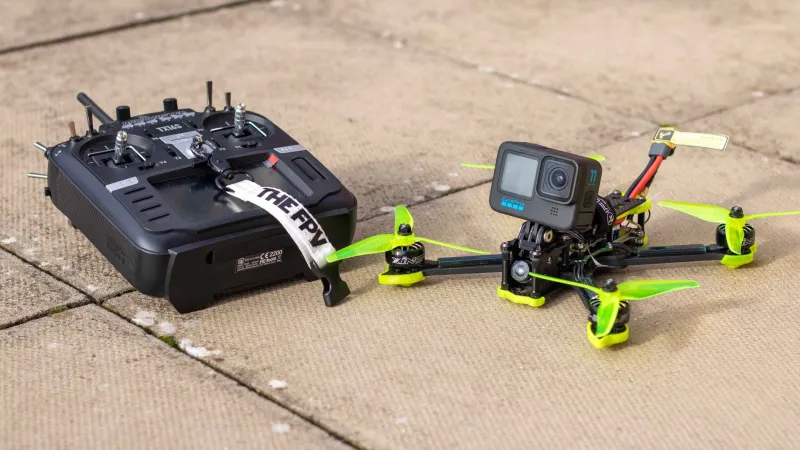
Smash Data: One Pilot's Obsessive Quest to Break the Same Quad 47 Times and Learn Something Every Time
Photo: Michael Bemmerl, CC BY 3.0 de, via Wikimedia Commons
The first thing you notice about Marcus Webb's garage in Knoxville, Tennessee is the wall. Not the workbench covered in soldering equipment, not the rows of LiPo batteries lined up by charge state, not even the 3D printer running a continuous loop of bracket prototypes. It's the wall—covered floor to ceiling in printed photographs of broken carbon fiber, each one labeled with a crash number, impact angle, and a short handwritten note about what snapped first.
Forty-seven crashes. Same basic frame geometry. Different variables each time. All of them intentional.
"People think I'm crazy," Webb says, pulling a half-rebuilt quad off the bench. "But every crash in this program told me something I couldn't learn any other way."
The Experiment Nobody Wanted to Run
Webb isn't a professional engineer. He's a 34-year-old HVAC technician who got into FPV racing through a local MultiGP chapter four years ago and developed an obsessive interest in why quads break the way they do. After watching his third frame crack at the arm-body junction during a race season, he started asking questions that the community's conventional wisdom couldn't fully answer.
"Everyone says 'buy a stiffer frame' or 'get thicker arms.' But stiffer and thicker compared to what? For which kind of impact? Nobody was actually testing this systematically. They were just trading opinions."
So Webb designed a test protocol. He built a rig—a modified trebuchet, essentially, that could launch a quad into a reinforced barrier at controlled angles and approximate speeds. He picked a mid-size 5-inch true-X geometry as his baseline, sourced a batch of identically manufactured frames from the same production run, and started breaking them.
He documented everything: impact angle, estimated velocity, point of first failure, propagation pattern of the crack, whether the stack survived, whether the motors survived, and how long a field repair would realistically take.
What the First Ten Crashes Revealed
The early results confirmed some things the community already suspected and blew up others.
Confirmed: arm-to-body joints are consistently the first failure point in direct frontal impacts. The geometry creates a stress concentration at the junction that even high-modulus carbon struggles to absorb cleanly. This is why so many race frames now use arm braces or extended body plates that distribute that load across a larger surface area.
Surprising: increasing arm thickness beyond a certain point actually increased damage propagation in oblique impacts. Thicker arms transferred more energy into the body plate on angled hits rather than absorbing it through controlled flex and fracture at the arm tip.
"That was the first counterintuitive result," Webb says. "A thinner arm that breaks cleanly at the tip is actually protecting your stack better than a thick arm that stays intact and transmits the full impact force through to center."
This finding has real-world implications. A lot of pilots upgrade to heavy-duty arms thinking they're buying durability. In certain crash scenarios, they're actually buying a more expensive main body failure.
The Role of Frame Geometry in Energy Distribution
By crash number 20, Webb had started varying the geometry more aggressively—changing arm angles, sweep angles, and body plate cutout patterns between test sessions. He was also consulting with a mechanical engineering student at the University of Tennessee who helped him start modeling stress distribution using basic finite element analysis software.
The geometry findings got interesting fast.
Conventional FPV wisdom holds that a stretched-X geometry (where the rear arms are swept back further than the front) is primarily a flight performance choice—better prop wash handling, different yaw authority characteristics. What Webb's crash data suggested is that stretched-X geometry also changes the crash energy distribution in meaningful ways.
In frontal impacts, stretched-X frames tended to absorb energy asymmetrically, with one front arm taking the primary hit while the swept rear geometry resisted torsional rotation. True-X frames, by contrast, distributed frontal impact energy more evenly across both front arms—which sounds better until you realize it means both arms are more likely to fail simultaneously, potentially sending the body plate into the ground as a single rigid unit.
"The stretched-X wasn't designed to be a better crash frame," Webb notes. "But the geometry has crash properties that nobody's really talking about."
Slow-Motion Told a Different Story Than the Damage
Around crash 25, Webb added a 240fps slow-motion camera to the test setup. What he captured changed how he interpreted the physical damage he'd been cataloging.
Frames that looked like they'd failed catastrophically—multiple breaks, shattered arm tips, cracked body plates—had actually failed in a sequence that protected the electronics stack better than some "cleaner" failures. The cascade of breaks was absorbing energy in stages rather than transmitting it in a single spike.
Conversely, frames that looked relatively intact after impact—one clean crack, minimal debris—had often transferred a high-G shock spike directly through to the flight controller. Webb started measuring FC survival rates alongside frame survival rates, and the correlation between frame damage and FC damage was weaker than he expected.
"You can have a frame that looks destroyed and an FC that's totally fine, or a frame that looks barely touched and a fried gyro. The frame is doing its job in the first case. In the second case, it failed at its actual job even though it looks okay."
This reframing—thinking of the frame as an energy management system rather than a structural survival system—is the conceptual shift that Webb says most pilots and even most frame designers are missing.
The Reinforcement Paradox
By the final stretch of testing, Webb had developed a set of findings he summarizes as the "reinforcement paradox": the locations where pilots most commonly add reinforcement are often not the locations where reinforcement provides the most protection.
Pilots tend to reinforce arm-body junctions (logical, since that's where they see failures). But Webb's data suggests that reinforcing the body plate's motor-mount-to-stack corridor—a less obvious structural line—does more to protect electronics across a broader range of impact scenarios.
Additionally, the cutout patterns in body plates, which designers typically optimize for weight reduction, have significant effects on crack propagation paths. Certain cutout geometries create stress channels that direct cracks toward the stack. Others redirect failure away from it. This isn't accidental in the best frame designs, but it's rarely documented or explained in product marketing.
What This Means for How You Buy and Build
Webb isn't claiming his garage test rig is a materials science lab. The sample sizes are small by academic standards, and real-world crash variables are far messier than a controlled trebuchet launch. But the directional findings are consistent enough that he's comfortable drawing some practical conclusions.
For pilots buying frames: look for designs with extended body plates that distribute arm junction stress, and pay attention to body plate cutout patterns—ask whether the designer has thought about crack propagation, not just weight.
For builders adding reinforcement: consider where your electronics live relative to your frame's structural lines, not just where you've seen carbon crack before.
For anyone who's ever written off a "destroyed" frame after a race wreck: pull it apart carefully before you trash it. The arm tips might be gone and the body might be intact. That's actually a frame doing exactly what a good frame should do.
Crash 47 is mounted in the center of the wall, labeled simply: "Best failure yet."
Webb is already designing crash 48.